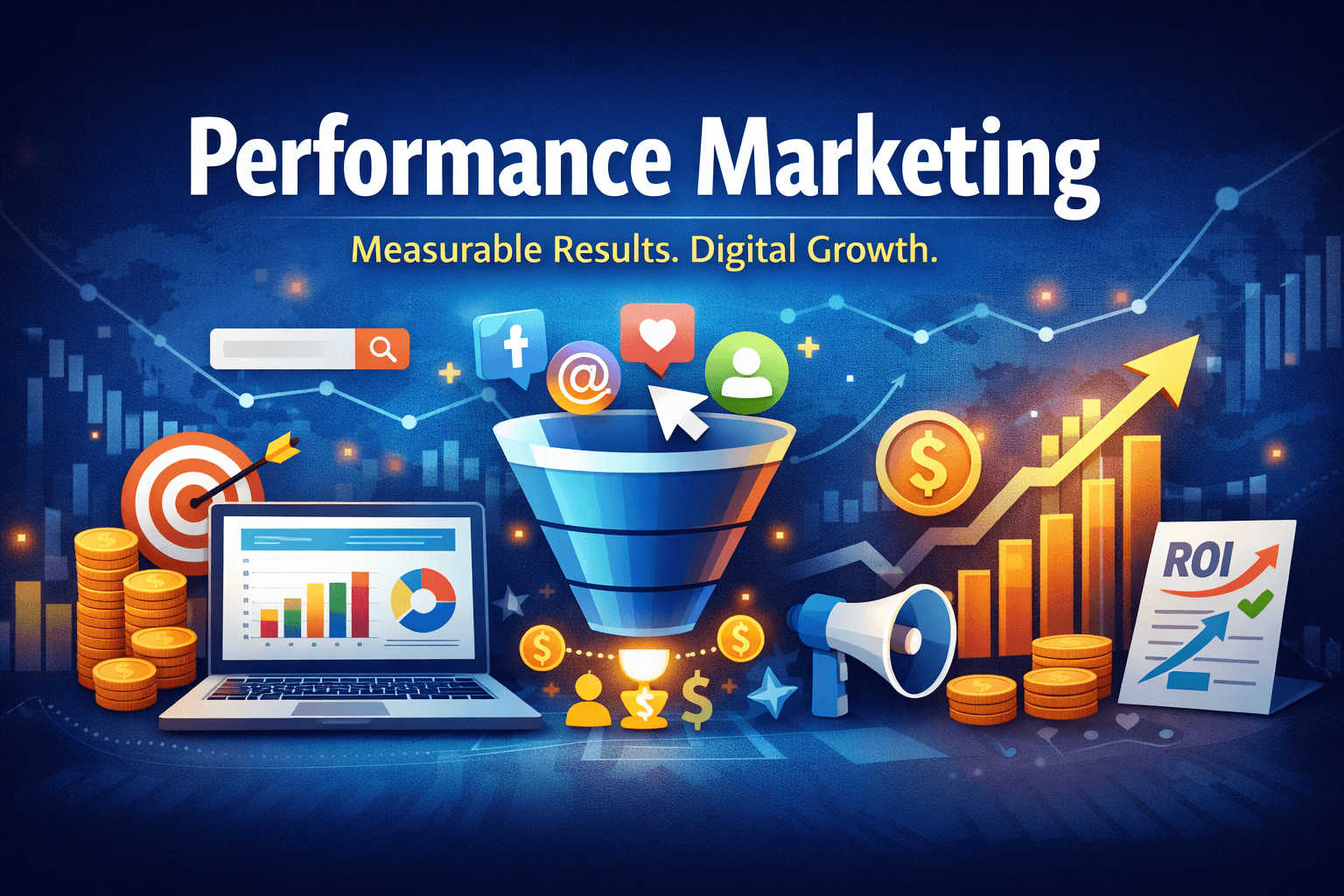
Performance Marketing: The Complete Guide to Measurable Digital Growth
Digital marketing is evolving rapidly. However, businesses today demand measurable results from their marketing investments. Instead of spending money on campaigns that only increase visibility, companies prefer strategies that generate real outcomes such as clicks, leads, and sales. Therefore, performance marketing becomes one of the most effective digital marketing strategies for modern businesses.
Moreover, brands want transparency and accountability when they invest in marketing. Traditional advertising often focuses on impressions and exposure, but it does not always guarantee measurable results. In contrast, ROI- Driven marketing allows businesses to track every action and pay only for successful outcomes. As a result, organizations gain better control over their marketing budgets and campaign performance.
In this guide, we explain what performance marketing is, how it works, the main channels involved, and why businesses increasingly rely on it to achieve digital growth.
What Is Performance Marketing?
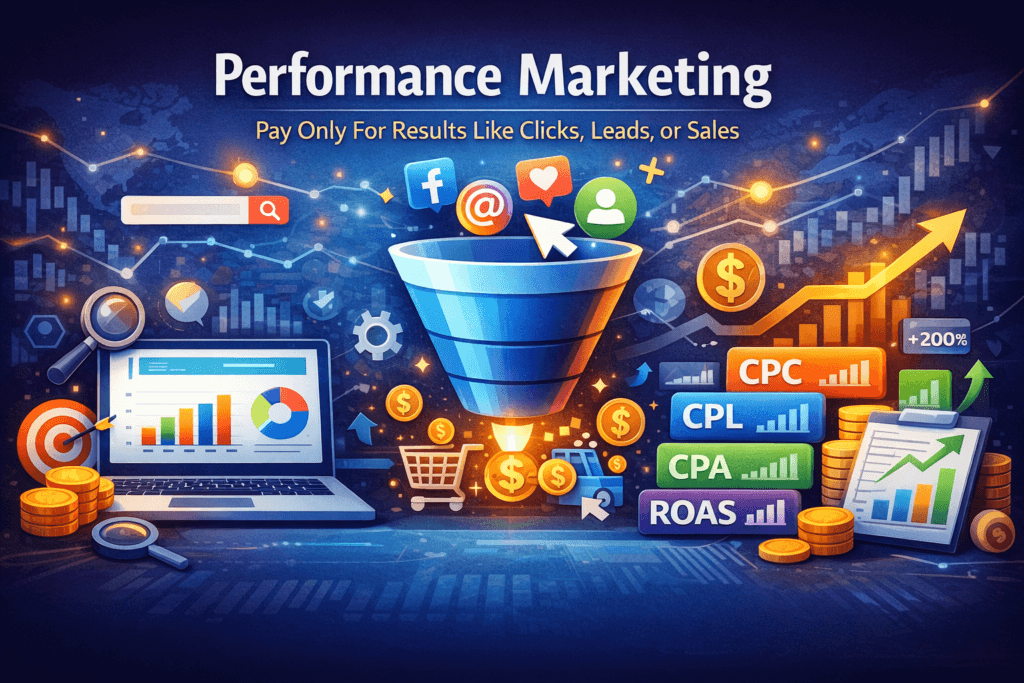
Performance marketing is a digital marketing strategy in which advertisers pay only when a specific action occurs. These actions may include clicks, leads, app installs, or completed purchases. Therefore, businesses pay for measurable performance rather than simply paying for ad visibility.
Unlike traditional advertising methods, result driven marketing focuses on results. Marketers monitor user interactions and track the effectiveness of every campaign. Consequently, companies clearly understand which marketing efforts generate conversions and which strategies require improvement.
Furthermore, direct response marketing uses several key metrics to evaluate success. These metrics include cost per click, cost per lead, cost per acquisition, and return on ad spend. Because of these measurable indicators, businesses can optimize campaigns and improve overall marketing performance.
How Performance Marketing Works
Understanding how pay-for-performance marketing works helps businesses implement effective campaigns. The process usually involves several stages that connect advertisers, marketing platforms, and target audiences.
First, marketers define campaign goals such as generating leads, increasing website traffic, or driving product sales. After that, they select appropriate advertising channels and design campaign creatives.
Next, the advertisements are displayed to targeted audiences through digital platforms. These platforms may include search engines, social media networks, or affiliate websites.
When users interact with advertisements, tracking systems record their actions. For example, when a user clicks an ad or completes a purchase, the system captures this information.
Finally, advertisers pay marketing partners only after the desired action occurs. Therefore, performance marketing ensures businesses invest in campaigns that deliver measurable results.
Key Channels Used in Performance Marketing
Successful performance marketing campaigns rely on multiple digital channels. Each channel plays a unique role in reaching audiences and generating conversions.

Search Engine Advertising
Search engines are one of the most powerful platforms for performance marketing. Businesses run paid advertisements that appear when users search for relevant keywords.
For example, when someone searches for “digital marketing services,” paid advertisements may appear at the top of search results. Advertisers pay only when users click these ads.
Because search engine advertising targets users who already show interest in specific products or services, it often generates high-quality leads.
Social Media Advertising
Social media platforms are also important channels for performance marketing. Platforms such as Facebook, Instagram, LinkedIn, and TikTok allow businesses to reach highly targeted audiences.
Marketers can segment audiences based on interests, demographics, location, and behavior. As a result, advertisements reach users who are more likely to engage with the content.
Furthermore, social media platforms provide detailed analytics that help marketers evaluate campaign performance. Therefore, marketers continuously optimize campaigns to improve results.
Affiliate Marketing
Affiliate marketing is another key component of performance marketing. In this model, businesses collaborate with affiliates who promote products or services through blogs, websites, or social media platforms.
Affiliates receive commissions only when their promotions generate successful outcomes such as sales or leads. Consequently, affiliate marketing becomes a low-risk strategy for businesses.
Additionally, affiliates often introduce products to new audiences. This expanded reach helps businesses grow their customer base.
Native Advertising
Native advertising integrates promotional content within the format of a website or digital publication. Unlike traditional banner ads, native advertisements blend naturally with surrounding content.
Because native advertisements feel less intrusive, users are more likely to engage with them. As a result, native advertising becomes a valuable channel in outcome- based marketing campaigns.
Performance Marketing vs Traditional Marketing
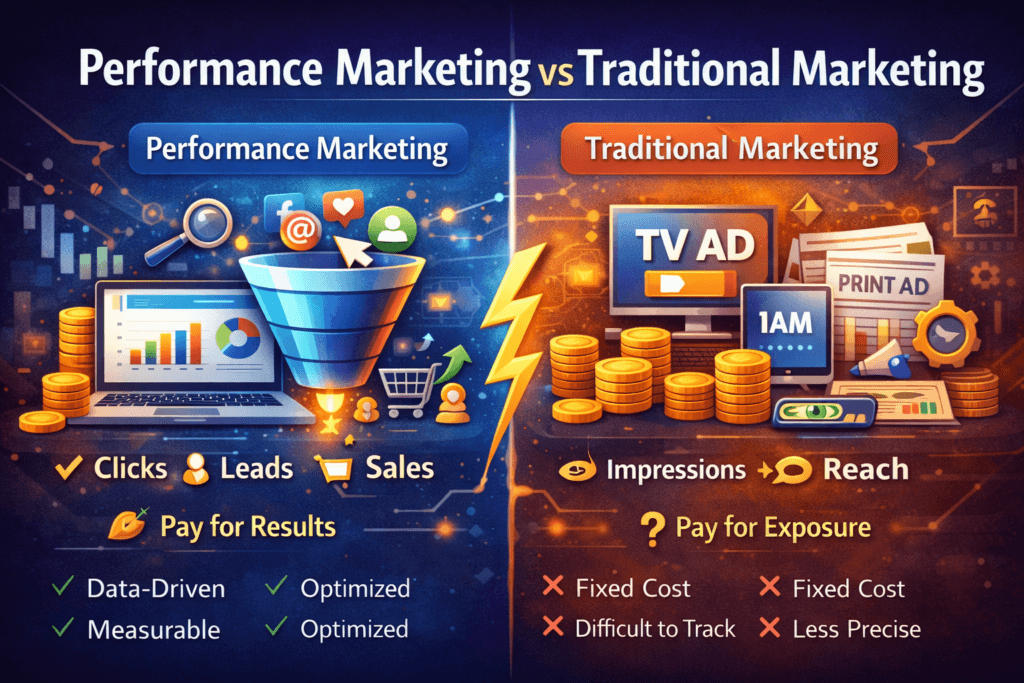
Traditional marketing methods focus primarily on brand awareness. Television advertisements, print ads, and billboards help businesses reach large audiences, but they often lack measurable results.
However, conversion marketing focuses on direct actions and measurable outcomes. Marketers analyze campaign data to understand which advertisements generate conversions.
Additionally, digital platforms provide real-time performance insights. Therefore, marketers can adjust campaigns quickly to improve results.
Consequently, performance marketing offers greater flexibility, transparency, and return on investment compared to traditional marketing approaches.
Key Metrics in Performance Marketing
Data analysis is essential in performance marketing. Marketers rely on several metrics to measure campaign success and optimize performance.
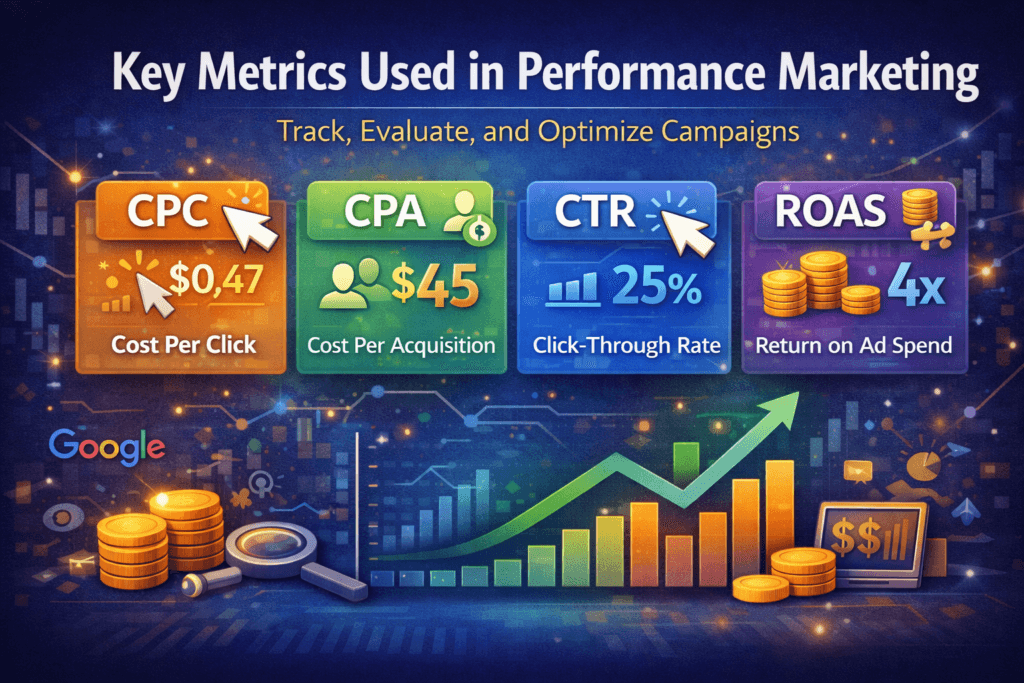
| Metric | Description |
|---|---|
| Cost Per Click (CPC) | The amount paid when a user clicks an advertisement |
| Cost Per Acquisition (CPA) | The cost required to acquire a new customer |
| Click-Through Rate (CTR) | Percentage of users who click an ad after seeing it |
| Return on Ad Spend (ROAS) | Revenue generated compared to advertising cost |
By analyzing these metrics, marketers can improve campaign effectiveness and increase profitability.
Best Performance Marketing Strategies
Successful performance marketing campaigns require strategic planning and continuous optimization.

Audience Targeting
First, marketers analyze audience behavior and preferences. By understanding customer interests and demographics, businesses deliver more relevant advertisements.
Conversion-Optimized Landing Pages
Additionally, landing pages play a crucial role in converting visitors into customers. High-performing landing pages include clear messaging, strong calls-to-action, and fast loading speeds.
Campaign Optimization
Marketers continuously analyze campaign data and adjust targeting settings, advertisement creatives, and bidding strategies. Consequently, campaigns become more efficient over time.
Retargeting Campaigns
Retargeting is another effective performance marketing tactic. It allows businesses to reconnect with users who previously visited their website but did not complete a purchase.
By displaying relevant advertisements to these users, businesses increase the likelihood of conversions.
The Role of Content in Conversion Marketing
Content marketing supports conversion marketing strategies by attracting and educating potential customers.
For example, informative blog articles help businesses improve search engine visibility. Educational content also builds trust and encourages users to engage with marketing campaigns.
Moreover, content marketing strengthens the customer journey. Users first discover helpful information, then interact with advertisements, and eventually become customers.
Therefore, combining content marketing with performance marketing creates a powerful digital growth strategy.
Therefore, web development plays a vital role in successful performance marketing strategies.
A high-converting website should include:
- Fast page loading speed
- Mobile-friendly design
- Clear navigation structure
- Strong call-to-action buttons
- Optimized landing pages
Without these elements, marketing campaigns may generate traffic but fail to produce conversions.
Consequently, businesses often combine web development services with conversion marketing strategies to maximize results.
How Digital Marketing Agencies Use Conversional Marketing
Digital marketing agencies help businesses implement data-driven conversional marketing strategies.
Typically, agencies follow a structured process:
- Conduct market research and competitor analysis
- Identify target audiences
- Create digital advertising campaigns
- Optimize landing pages and website content
- Monitor campaign performance using analytics tools
- Continuously improve strategies based on data insights
Through this approach, agencies ensure marketing investments generate measurable growth.
The Future of Performance Marketing
The future of performance marketing continues to evolve with advancements in technology and data analytics.
Artificial intelligence is increasingly used to automate campaign optimization and improve targeting accuracy. Additionally, advanced analytics tools provide deeper insights into customer behavior.
Furthermore, personalized advertising experiences are becoming more common. Businesses create customized marketing messages that resonate with specific audiences.
As digital platforms continue to expand, performance marketing will remain a critical strategy for businesses seeking measurable growth.
Performance Marketing Examples from Real Businesses
Understanding real-world examples helps businesses see how Outcome – based marketing works in practice. Many companies across industries use this strategy to achieve measurable growth and improve marketing efficiency.
For example, e-commerce companies often run search advertising campaigns targeting customers who actively search for products online. When users search for specific items, businesses display relevant advertisements at the top of search results. If a user clicks the advertisement and completes a purchase, the company pays for that successful conversion. Therefore, marketing budgets are spent only on campaigns that generate revenue.
Similarly, mobile application companies rely heavily on performance marketing to increase app downloads. In this strategy, marketers promote the app through social media advertisements, influencer collaborations, and affiliate networks. Businesses pay advertising partners only when users install the application. As a result, companies can track user acquisition costs and optimize campaigns to attract high-quality users.
Another example appears in affiliate marketing programs. Many bloggers, influencers, and content creators promote products through their websites or social media platforms. These affiliates receive a commission whenever their promotional links generate sales. Consequently, businesses expand their market reach without paying for advertisements that fail to produce results.
Subscription-based services also benefit from performance marketing strategies. Streaming platforms, online education providers, and software companies frequently run paid campaigns to attract new subscribers. Marketers analyze campaign data to determine which advertisements produce the highest number of sign-ups. Based on this information, they optimize marketing strategies to maximize customer acquisition.
These examples demonstrate how performance marketing allows businesses to focus on results instead of simply increasing advertising exposure.
Challenges Businesses Face in Performance Marketing
Although conversion marketing offers many advantages, businesses also face certain challenges when managing campaigns. However, understanding these challenges helps marketers develop more effective strategies.
First, competition in digital advertising continues to increase. Many companies target similar audiences and keywords, which can increase advertising costs. Therefore, marketers must constantly optimize campaigns to maintain profitability and achieve better return on investment.
Another challenge involves accurate data tracking. Successful performance marketing campaigns rely on detailed analytics and conversion tracking tools. However, changes in privacy regulations and browser tracking policies sometimes make data collection more complex. As a result, marketers must adopt advanced tracking technologies to maintain campaign accuracy.
Additionally, creating engaging advertisement creatives is essential. Even if a campaign targets the right audience, poor advertisement design may reduce click-through rates. Therefore, marketers need to test multiple advertisement variations to identify which messages resonate best with their audience.
Despite these challenges, businesses that rely on data-driven strategies and continuous optimization can achieve strong results with Result- driven marketing.
Tools Used for Conversion Marketing Campaigns
Modern marketers use various digital tools to manage and optimize ROI driven marketing campaigns effectively. These tools provide valuable insights into campaign performance and help businesses improve marketing efficiency.
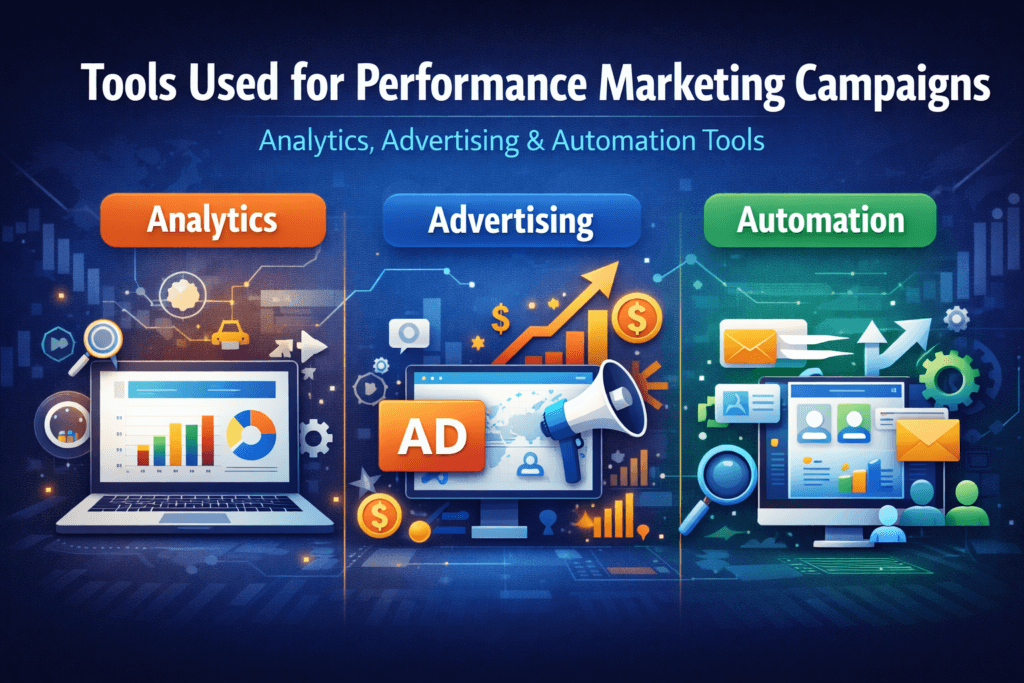
Analytics platforms play a critical role in performance marketing. These tools track website traffic, user behavior, and conversion data. Marketers analyze this information to understand how users interact with advertisements and landing pages.
Advertising platforms also provide built-in performance tracking features. Marketers can monitor key metrics such as impressions, clicks, conversions, and return on investment directly from these dashboards. This information allows businesses to adjust campaigns quickly when necessary.
Marketing automation tools also help streamline campaign management. These platforms allow businesses to automate tasks such as email marketing, audience segmentation, and lead nurturing. Consequently, marketing teams can focus more on strategy and optimization.
By using advanced analytics and automation tools, businesses improve campaign performance and achieve better results from their conversion marketing strategies.
Conclusion
In today’s competitive digital landscape, businesses require marketing strategies that deliver measurable results. Performance marketing provides a powerful solution by connecting marketing investment directly to customer actions such as clicks, leads, and purchases.
Moreover, this strategy enables businesses to analyze campaign performance, optimize marketing efforts, and maximize return on investment.
By combining outcome – based marketing with web development, content marketing, and data analytics, businesses can build highly effective marketing campaigns that drive long-term growth.
Therefore, companies that adopt performance marketing strategies gain a significant advantage in the digital marketplace.
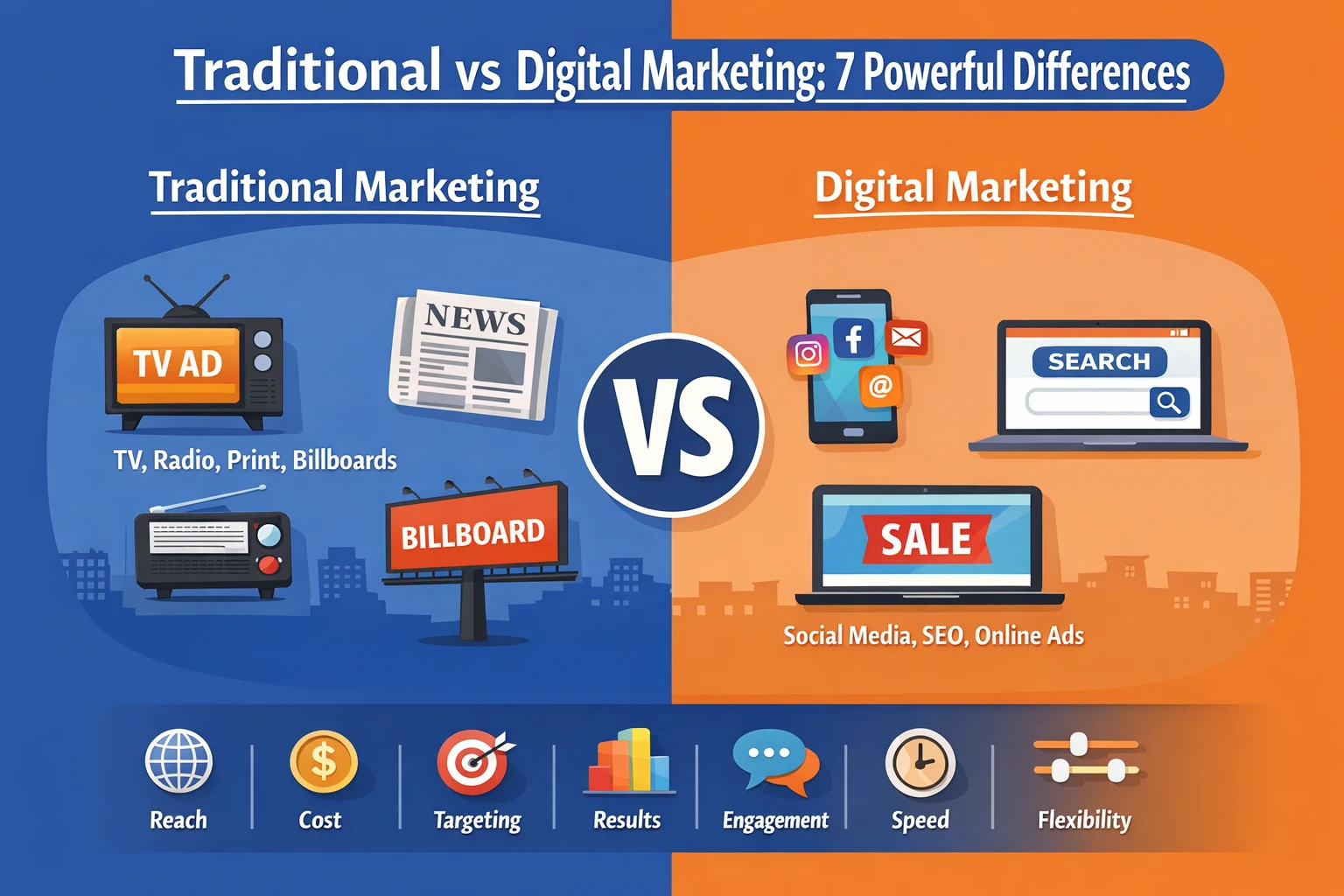
Discover 7 powerful differences between traditional vs digital marketing
Traditional vs Digital Marketing: 7 Powerful Differences
Marketing plays a vital role in the success of any business. Companies promote products, communicate with customers, and build brand awareness through different marketing strategies. However, marketing methods evolve significantly as technology changes. Because of this evolution, businesses often compare traditional vs digital marketing to understand which approach works better for modern markets.
Traditional marketing includes offline promotional techniques such as television commercials, radio advertisements, newspaper ads, billboards, brochures, and direct mail campaigns. These marketing channels help companies reach large audiences and create strong brand recognition. For decades, businesses rely heavily on these methods to promote products and services.
On the other hand, digital marketing focuses on online platforms. Businesses use websites, search engines, social media platforms, email campaigns, and online advertising to connect with customers. Because internet usage increases worldwide, digital marketing becomes an essential strategy for companies that want to reach modern consumers.
Therefore, understanding the differences between traditional vs digital marketing helps businesses choose effective marketing strategies that align with their goals, audience, and budget.
What Is Traditional Marketing?
Traditional marketing refers to promotional methods that use offline communication channels. Businesses rely on physical and broadcast media to deliver marketing messages to their audience.
Common Traditional Marketing Channels
Traditional marketing uses several channels to promote products and services.
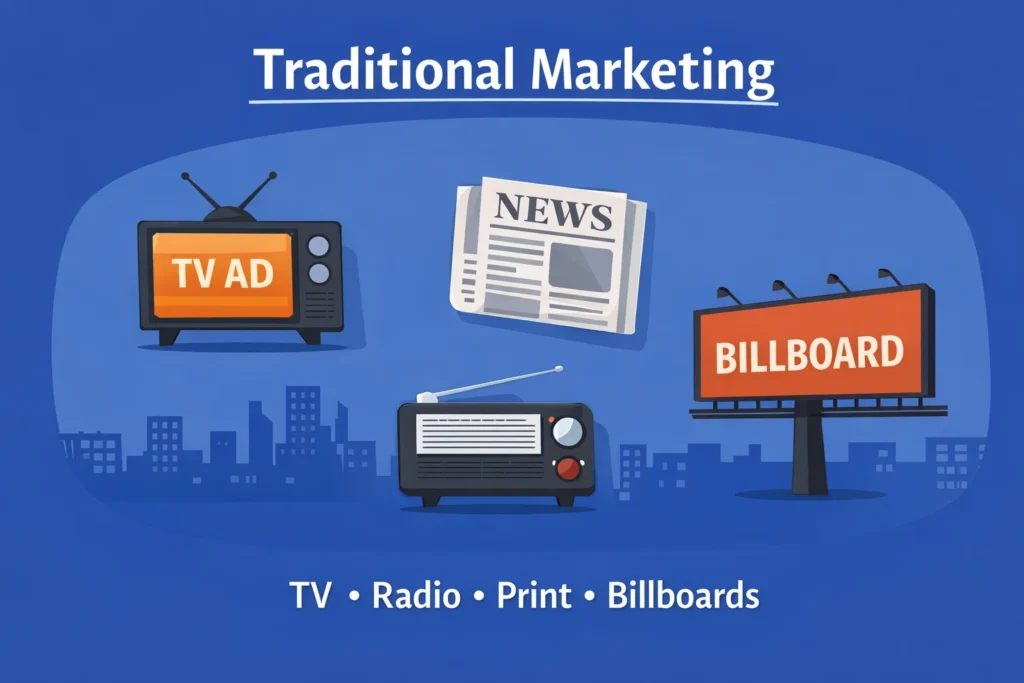
Television Advertising
Television commercials allow businesses to present visual advertisements to large audiences. Companies often display commercials during popular programs to increase brand visibility.
Print Advertising
Print advertisements appear in newspapers, magazines, brochures, and flyers. Businesses distribute printed materials to attract local audiences.
Radio Advertising
Radio advertisements help companies promote products through audio messages broadcast to listeners.
Outdoor Advertising
Outdoor advertising includes billboards, posters, banners, and transit advertisements placed in high-traffic areas.
These marketing methods often help businesses create brand awareness and reach audiences who rely on traditional media.
What Is Digital Marketing?
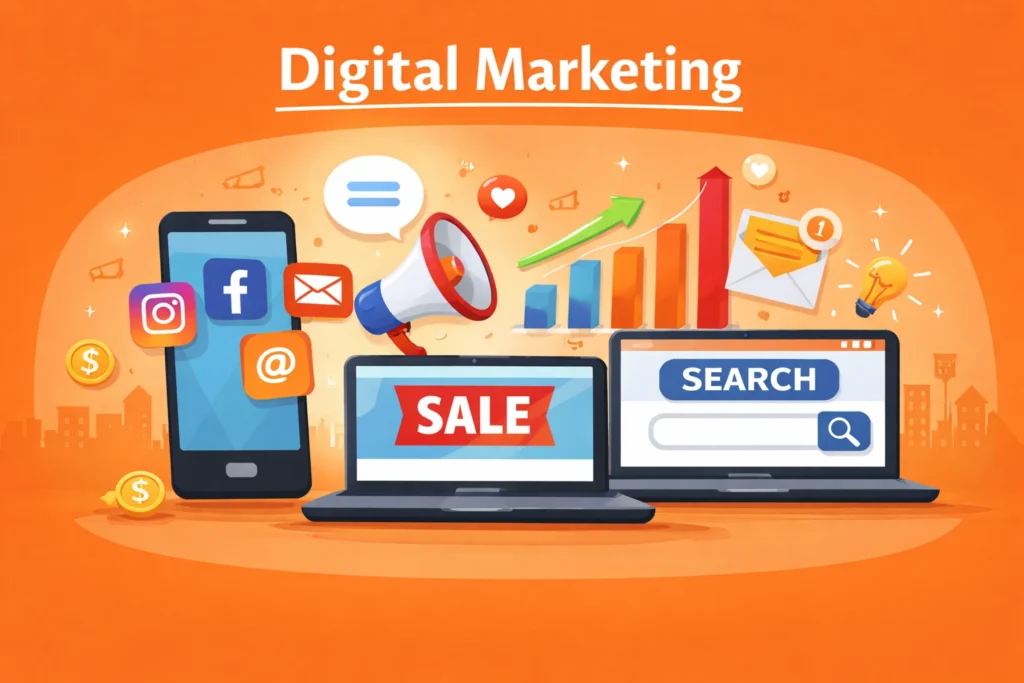
Digital marketing refers to promoting products and services through internet-based platforms. Businesses connect with customers online using websites, social media platforms, search engines, and digital advertisements.
Popular Digital Marketing Channels
Several digital marketing strategies help businesses grow their online presence.
Search Engine Optimization (SEO)
SEO improves website visibility on search engines such as Google. Businesses optimize website content so that it appears higher in search results.
Social Media Marketing
Social media marketing allows companies to promote products through platforms like Facebook, Instagram, LinkedIn, and Twitter.
Pay-Per-Click Advertising (PPC)
PPC advertising enables businesses to display ads on search engines or social platforms. Advertisers pay only when users click on their advertisements.
Content Marketing
Content marketing focuses on creating valuable content such as blogs, videos, and infographics that attract and educate audiences.
Email Marketing
Email marketing helps businesses communicate directly with customers by sharing offers, updates, and newsletters.
Because digital marketing relies on online platforms, businesses can easily track campaign performance and optimize their strategies.
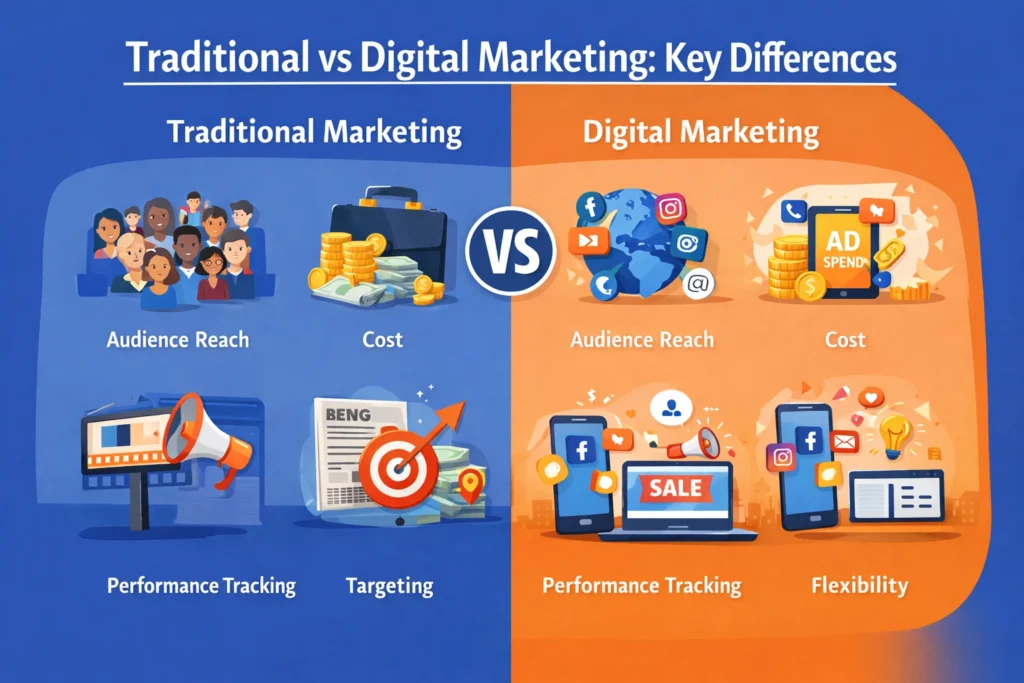
Traditional vs Digital Marketing: Key Differences
Understanding the differences between traditional vs digital marketing helps businesses select the most suitable promotional strategy.
1. Audience Reach
Traditional marketing reaches audiences through television, newspapers, and outdoor advertisements. Although these platforms reach large audiences, they often target broad groups without specific segmentation.
Digital marketing, however, allows businesses to reach global audiences through the internet. Companies promote products to people in different locations simultaneously.
Therefore, digital marketing provides wider and more flexible audience reach.
2. Cost of Marketing Campaigns
Traditional marketing campaigns often require significant investment. Television advertisements, print media placements, and billboard advertisements involve high production and distribution costs.
In contrast, digital marketing offers cost-effective promotional opportunities. Businesses launch online campaigns with flexible budgets and scale them gradually.
Because of lower costs, digital marketing becomes accessible even for startups and small businesses.
3. Target Audience Precision
Traditional marketing targets audiences based on general demographics or geographic locations. For example, newspaper advertisements target readers within a particular city or region.
Digital marketing provides advanced audience targeting. Businesses choose audiences based on age, interests, online behavior, location, and purchasing preferences.
As a result, digital marketing ensures advertisements reach the most relevant customers.
4. Measurable Results
Another major difference between traditional vs digital marketing lies in performance measurement.
Traditional marketing campaigns often provide limited data. Businesses find it difficult to measure how many people respond to a billboard or newspaper advertisement.
Digital marketing, however, provides detailed analytics. Marketers track metrics such as website visits, clicks, engagement rates, and conversions.
Consequently, businesses analyze performance easily and improve campaigns continuously.
5. Customer Engagement
Traditional marketing mainly delivers one-way communication. Customers receive marketing messages through advertisements but rarely interact directly with brands.
Digital marketing encourages interactive communication. Customers comment on social media posts, share content, and communicate directly with companies through messages or reviews.
This interaction builds stronger relationships between businesses and their audiences.
6. Campaign Speed
Traditional marketing campaigns require more preparation time. Designing advertisements, printing materials, and scheduling broadcast commercials often take several days or weeks.
Digital marketing campaigns launch much faster. Businesses create advertisements, publish content, and start campaigns within minutes.
Therefore, digital marketing allows companies to respond quickly to market trends.
7. Flexibility and Optimization
Traditional marketing campaigns remain fixed after launch. Making changes to printed advertisements or television commercials often requires additional cost.
Digital marketing campaigns remain highly flexible. Marketers modify advertisements, keywords, and targeting options in real time.
Because of this flexibility, businesses optimize campaigns continuously for better results.
Advantages of Digital Marketing
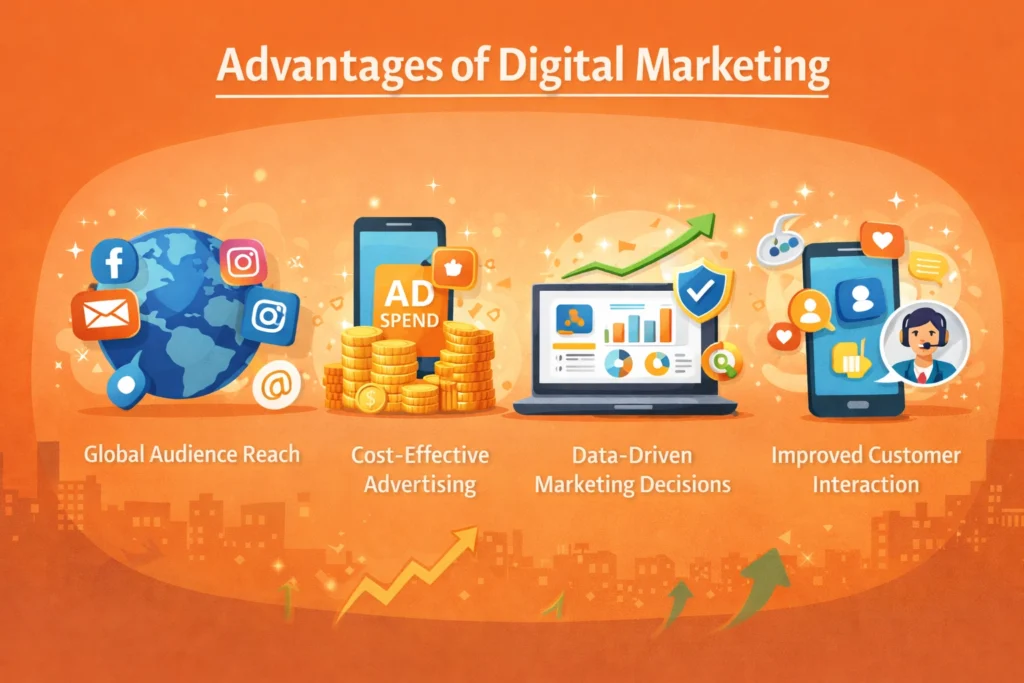
Digital marketing offers several benefits that help businesses grow efficiently.
Global Audience Reach
Online platforms allow businesses to reach customers worldwide. Therefore, companies expand their markets beyond geographic boundaries.
Cost-Effective Advertising
Digital marketing campaigns require lower budgets compared to traditional advertising methods.
Data-Driven Marketing Decisions
Businesses analyze campaign performance using real-time analytics and optimize strategies accordingly.
Improved Customer Interaction
Social media platforms allow brands to communicate directly with customers and build lasting relationships.
Because of these advantages, digital marketing becomes the preferred strategy for many modern businesses.
Advantages of Traditional Marketing
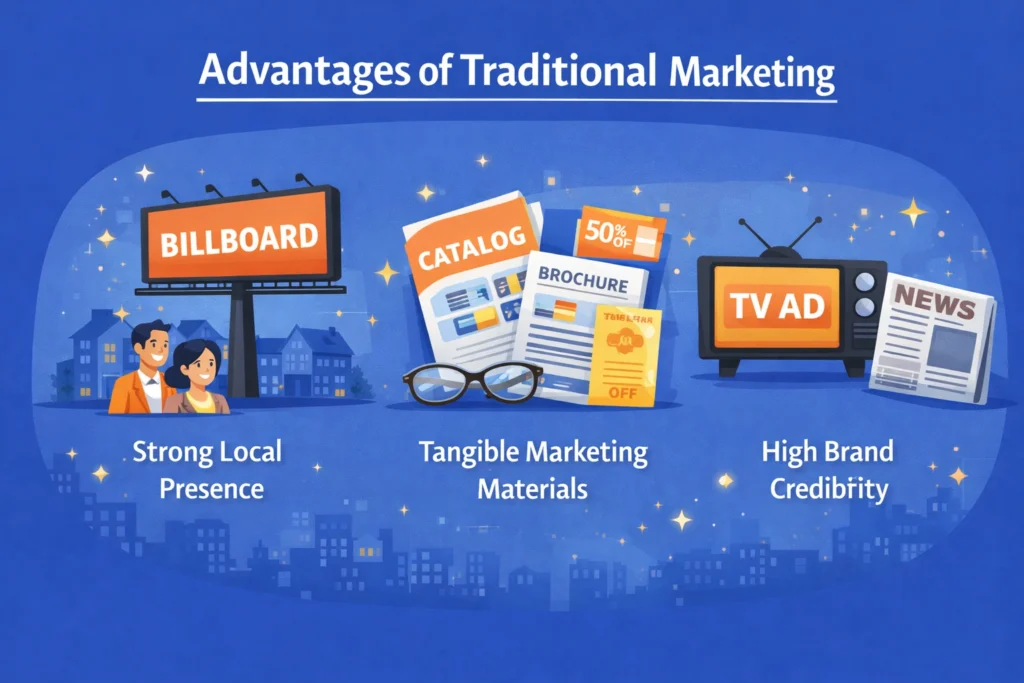
Although digital marketing dominates the modern marketing landscape, traditional marketing still offers valuable benefits.
Strong Local Presence
Traditional marketing methods such as billboards and local newspapers effectively reach nearby audiences.
Tangible Marketing Materials
Printed brochures, catalogs, and flyers provide physical promotional materials that customers can review later.
High Brand Credibility
Many consumers still trust advertisements from established media channels such as television and newspapers.
Therefore, traditional marketing continues to play an important role in many industries.
Real-World Marketing Examples
Understanding traditional vs digital marketing becomes easier when examining real-world business scenarios.
For example, a local retail store often advertises products through printed flyers and newspaper advertisements. These traditional marketing strategies attract customers living nearby.
However, the same business also benefits from digital marketing. By creating a website and social media profiles, the store promotes products online and reaches a wider audience.
Similarly, e-commerce companies rely heavily on digital marketing strategies. They use SEO, Google Ads, content marketing, and social media campaigns to attract online shoppers.
Therefore, many businesses combine both traditional and digital marketing strategies to maximize their reach and improve overall marketing performance.
Future of Marketing Strategies
Marketing continues to evolve rapidly as technology advances. Consumers spend increasing amounts of time online, which encourages businesses to invest more in digital marketing strategies.
Artificial intelligence, data analytics, and marketing automation tools allow businesses to deliver personalized marketing experiences.
Although traditional marketing still plays an important role in brand awareness, digital marketing increasingly becomes the primary marketing channel for modern businesses.
Therefore, companies that adapt their strategies to digital platforms often achieve stronger growth and customer engagement.
Conclusion
Understanding the differences between traditional vs digital marketing helps businesses choose the right strategy for their goals. Traditional marketing uses offline channels such as television, radio, newspapers, and billboards to reach audiences. Digital marketing, however, uses online platforms such as search engines, websites, and social media to connect with customers.
Both marketing approaches offer unique advantages. Traditional marketing helps businesses build local brand recognition, while digital marketing provides targeted advertising, measurable results, and cost-effective promotional opportunities.
Therefore, many successful companies combine both strategies to achieve balanced marketing results. As technology continues to evolve, businesses that adapt their marketing strategies to modern digital platforms will remain competitive and continue to grow.
Affordable Digital Marketing from Garage to Global
Introduction:
In today’s competitive digital world, businesses look for growth strategies that deliver results without high costs. Affordable digital marketing with garage2global becomes a practical solution for startups, small businesses, and growing brands that want visibility, leads, and conversions without overspending. Instead of complex marketing models, this approach focuses on clarity, performance, and scalability.
At DigiTeamAI, we follow the same philosophy by offering affordable digital marketing services that support businesses from the garage stage to global recognition.
Pricing Explanation: Transparent & Startup-Friendly
Affordable digital marketing does not mean unclear or hidden pricing. Our approach is designed to give startups and small businesses maximum value within a realistic budget. Instead of charging high monthly retainers like traditional agencies, we offer flexible and scalable pricing based on your business goals.
You pay only for the services you need—whether it’s SEO, social media management, paid advertising, or website optimization. This ensures your marketing spend is controlled, predictable, and aligned with your growth stage. As your business expands, your digital marketing plan can grow with you—without sudden cost jumps.
Who Should Choose Affordable Digital Marketing?
Affordable online growth strategies ideal for:
1. Startups launching their brand and needing quick online visibility
2. Small businesses that want steady leads without overspending
3. Local businesses looking to improve local SEO and customer reach
4. Entrepreneurs and solopreneurs managing limited marketing budgets
5. Growing companies that want results before investing in large agencies
6. If you want professional digital marketing support but don’t want to commit to expensive long-term contracts, affordable digital marketing is the smart choice.
Approach of Affordable Digital Marketing with Garage2Global
The garage2global mindset focuses on growth from the ground up. It supports businesses that start small but aim big. Affordable digital marketing with garage2global follows a structured process that emphasizes learning, testing, and scaling.
This approach includes:
Clear goal setting
Budget-friendly campaign planning
Data-driven optimization
Scalable digital systems
Consequently, businesses move forward step by step without unnecessary risks.
How Affordable Digital Marketing Helps Businesses to Grow
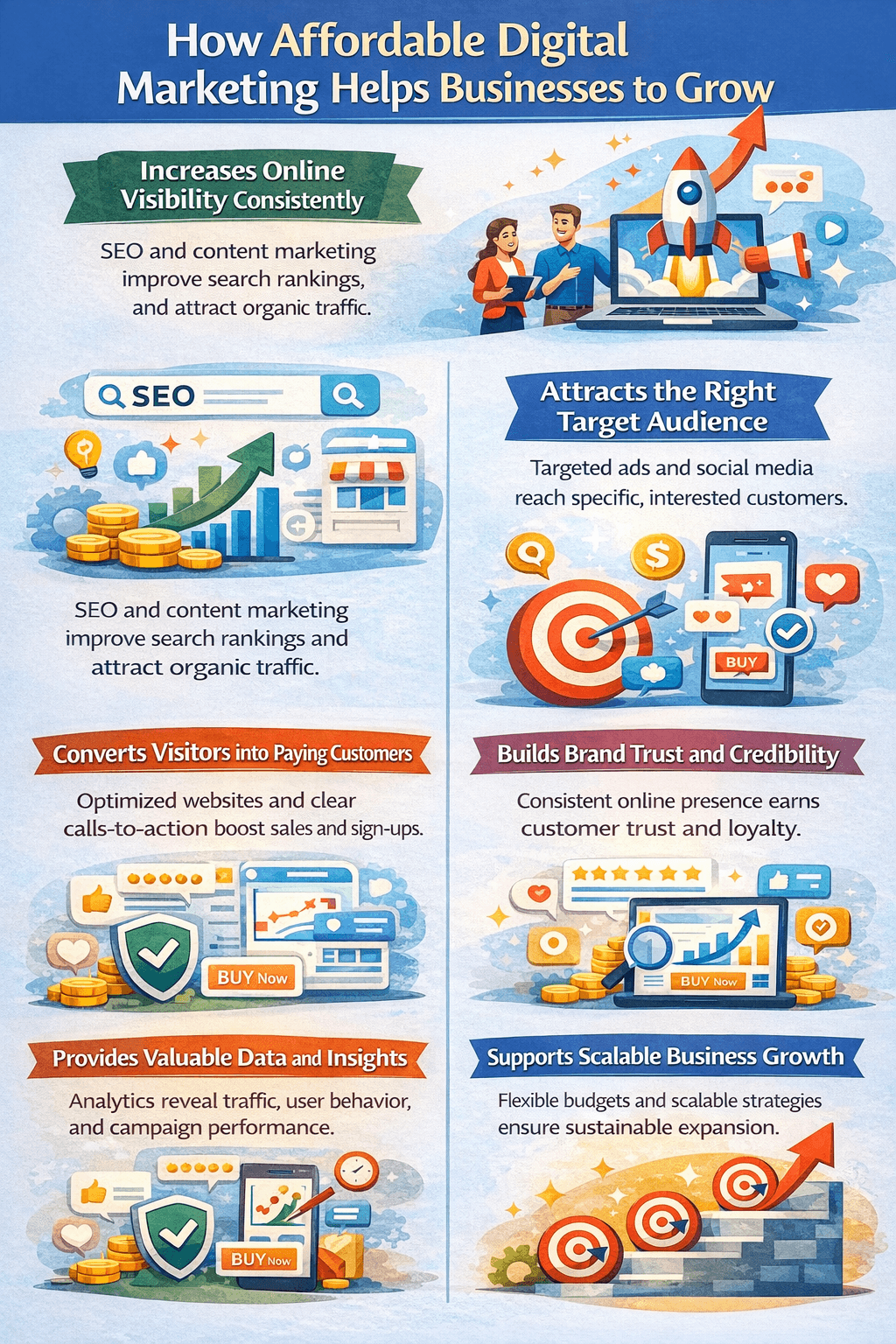
Budget-friendly digital marketing helps businesses grow by creating strong online visibility without putting pressure on budgets. Today, customers search online before making buying decisions. Therefore, businesses that invest in cost-effective digital strategies stay visible, competitive, and relevant in their market.
Increases Online Visibility Consistently
First, affordable digital marketing improves online visibility through search engine optimization and content marketing. SEO helps businesses rank higher on search engines, while optimized content answers customer questions clearly. As a result, websites attract organic traffic from users who actively search for products or services.
Moreover, regular blog posts, service pages, and local SEO listings help businesses appear in search results consistently. Consequently, even small businesses compete with larger brands without spending heavily on advertising.
Attracts the Right Target Audience
Second, affordable digital marketing focuses on attracting the right audience instead of reaching everyone. Paid advertising platforms allow businesses to target users based on location, interests, behavior, and intent. Therefore, marketing efforts reach people who are more likely to convert.
In addition, social media marketing helps brands connect with their ideal customers directly. Businesses share helpful content, promotional updates, and brand stories that build trust over time. As engagement grows, brand awareness improves naturally.
Converts Visitors into Paying Customers
Third, affordable digital marketing supports conversion optimization through well-designed websites and landing pages. A fast, mobile-friendly website improves user experience and reduces bounce rates. Therefore, visitors stay longer and explore more pages.
Additionally, clear call-to-action buttons guide users toward desired actions such as inquiries, sign-ups, or purchases. Optimized landing pages focus on one goal, which increases conversion rates without increasing ad spend.
Builds Brand Trust and Credibility
With consistent digital marketing builds trust and credibility. When businesses appear regularly in search results and social platforms, customers perceive them as reliable. Reviews, testimonials, and educational content strengthen this trust further.
As a result, customers feel confident choosing a brand they recognize and understand. Over time, this trust leads to repeat business and long-term customer relationships.
Provides Valuable Data and Insights
Another major benefit of affordable digital marketing is access to real-time data and analytics. Businesses track website traffic, user behavior, conversion rates, and campaign performance easily. Therefore, every marketing decision becomes informed and strategic.
In addition, analytics help identify what works and what needs improvement. Businesses adjust strategies quickly, which saves time and money while improving results.
Supports Scalable Business Growth
Cost-effective online marketing grows with the business. Small campaigns start with limited budgets, and successful strategies scale gradually. Consequently, businesses expand their reach without financial risk.
Moreover, digital channels remain flexible. Businesses pause, modify, or increase campaigns based on performance and goals. This flexibility ensures sustainable growth in competitive markets.
Enhances Local and Global Reach
Affordable digital marketing also helps businesses reach both local and global audiences. Local SEO attracts nearby customers, while social media and content marketing expand reach beyond geographic limits. Therefore, businesses grow without opening physical locations.
At the same time, consistent branding across platforms strengthens recognition everywhere customers search.
Key Benefits of Affordable Digital Marketing
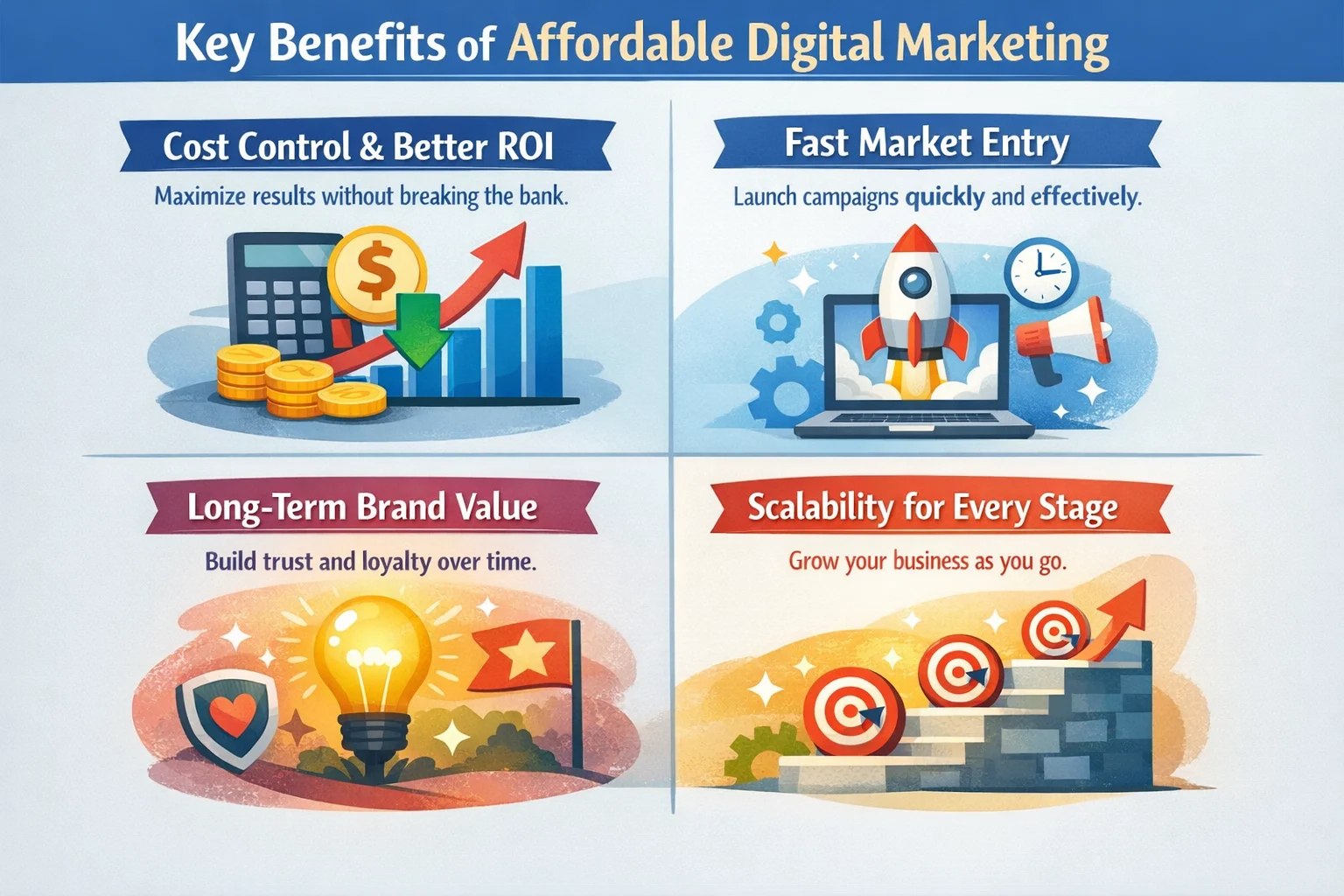
Budget-friendly digital marketing ensures that online marketing remains accessible and effective. Instead of high-cost campaigns, this approach uses strategic planning, smart tools, and data-backed decisions.
First, it prioritizes channels that bring results. Then, it tests and refines campaigns continuously. Finally, it scales what works best. Therefore, businesses grow with confidence and control.
Core Online Marketing Services Designed for Real Growth
Search Engine Optimization for Long-Term Visibility
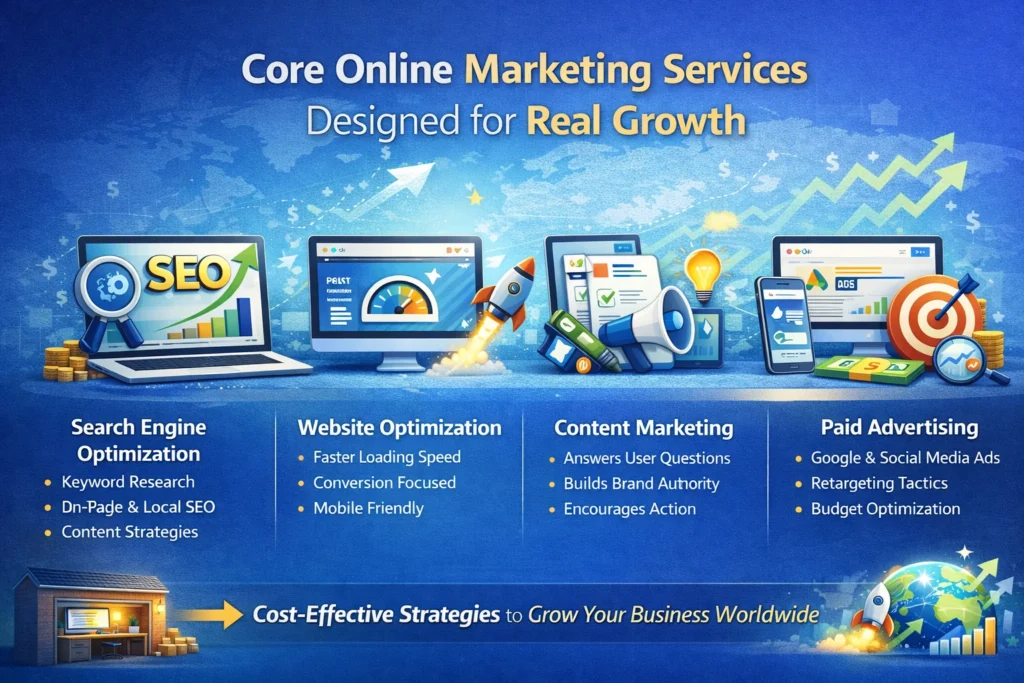
SEO builds organic visibility and trust. Online Marketing Services by Garage2Global use SEO to attract users who actively search for solutions.
This includes:
Keyword research and mapping
On-page and technical optimization
Local SEO targeting
Content-driven ranking strategies
As a result, businesses gain steady traffic without ongoing ad dependency
Website Optimization for Better Conversions
Online marketing succeeds when visitors convert into leads or customers. Therefore, website optimization remains essential.
Garage2Global-based strategies focus on:
Clear messaging
Fast loading speed
Mobile responsiveness
Strong calls to action
As a result, every visit delivers value.
Content Marketing That Educates and Converts
Content plays a central role in online growth. Blogs, service pages, and landing pages help users understand value clearly.
Affordable digital marketing with garage2global emphasizes content that:
Answers real user questions
Supports SEO goals
Builds brand authority
Encourages action
Therefore, content becomes a long-term growth asset.
Paid Advertising with Budget Efficiency
Paid marketing drives immediate visibility when managed properly. Online Marketing Services by Garage2Global focus on performance-driven paid campaigns rather than high spending.
These services include:
Google Ads campaign management
Social media paid promotions
Retargeting and conversion tracking
Continuous ad optimization
Consequently, businesses achieve higher ROI with controlled budgets.
As a result, every visit delivers value.
From Local Reach to Global Presence
With consistent digital efforts, even small brands can reach international audiences. Search engines, social media platforms, and online marketplaces remove geographical barriers. A clear brand message, optimized content, and audience targeting make global expansion achievable, even on a controlled budget.
How DiGiTeamAI Provides Affordable Digital Marketing
DiGiTeamAI helps businesses grow by offering customized digital marketing solutions that match their budget and goals. We focus on practical strategies, transparent pricing, and measurable results. Our team supports startups and small businesses by simplifying marketing, eliminating unnecessary expenses, and delivering scalable solutions that grow with the brand.
Conclusion
Affordable digital marketing proves that success does not depend on how big you start, but how smart you grow. With the right strategy, even a garage-based idea can reach global audiences. By choosing efficient digital tools and trusted expertise, businesses can build sustainable growth without financial pressure.

Digital Marketing Remote Jobs: A Complete Guide for Freelancing Digital Marketing Agencies
Digital marketing remote jobs are transforming how freelancing digital marketing agencies operate and grow. With businesses moving online and embracing flexible work models, remote digital marketing roles have become a powerful opportunity for agencies, freelancers, and brands alike.
In this guide, you’ll learn what digital marketing remote jobs are, the most in-demand roles, required skills, and how freelancing agencies can benefit by building remote teams.
What Are Digital Marketing Remote Jobs?
Digital marketing remote jobs are roles that allow professionals to work from any location while managing online marketing activities. These jobs rely on internet-based tools, cloud platforms, and digital communication instead of physical office spaces.
For a freelancing digital marketing agency, remote jobs make it easier to hire skilled professionals globally and deliver high-quality services without geographical limits.
Why Digital Marketing Remote Jobs Are in High Demand
Remote work has become a preferred choice for both businesses and professionals. Here’s why digital marketing remote jobs continue to grow:
- Increased demand for online visibility
- Cost-effective hiring for agencies
- Flexible work environments for professionals
- Access to global clients and markets
- Faster project execution using digital tools
As a result, freelancing digital marketing agencies are adopting remote work models to stay competitive.
Top Digital Marketing Remote Jobs for Freelancing Agencies
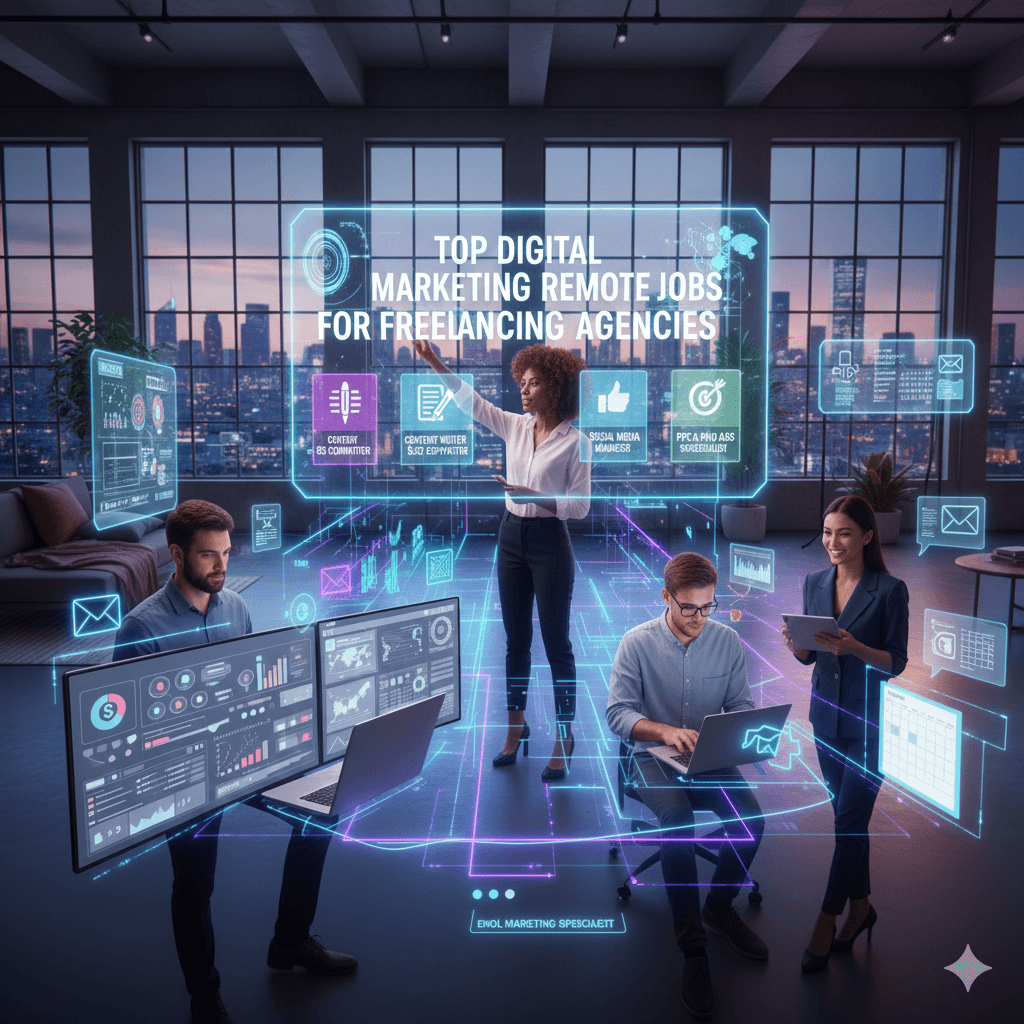
SEO Specialist (Remote)
Remote SEO specialists focus on keyword research, on-page SEO, technical optimization, and link building to improve search engine rankings and organic traffic.
Content Writer & SEO Copywriter
Content writers create SEO-friendly blogs, landing pages, website content, and marketing copy that drives engagement and conversions.
Social Media Manager
Remote social media managers handle content planning, posting, audience engagement, and analytics across platforms like Instagram, Facebook, LinkedIn, and X.
PPC & Paid Ads Specialist
These professionals manage Google Ads, Facebook Ads, and other paid campaigns to generate qualified leads and maximize ROI.
Email Marketing Specialist
Email marketers design, automate, and optimize email campaigns to nurture leads and increase customer retention.
Skills Required for Digital Marketing Remote Jobs
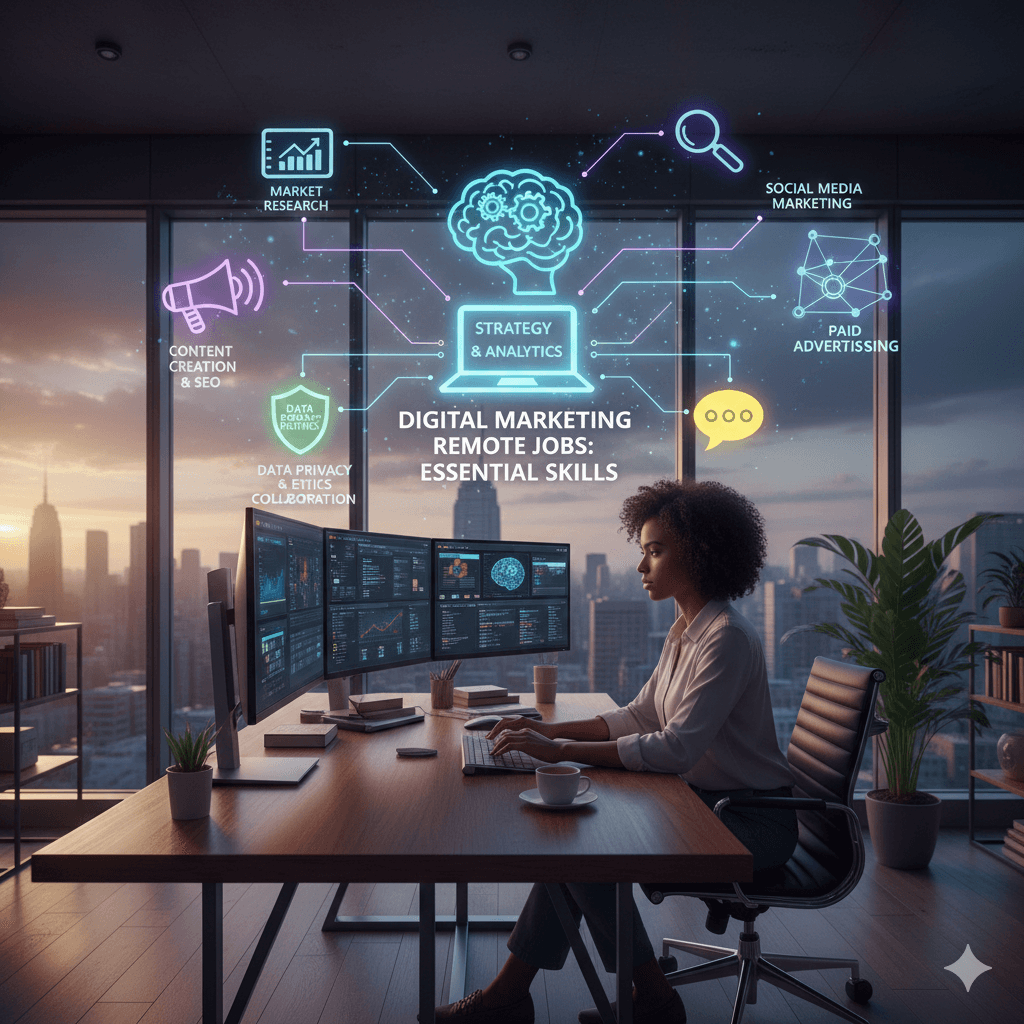
To succeed in digital marketing remote jobs, professionals should have:
- Strong communication and collaboration skills
- Time management and self-discipline
- Knowledge of SEO, content marketing, and social media
- Experience with analytics and reporting tools
- Familiarity with automation and AI-based tools
Freelancing digital marketing agencies benefit when their remote teams continuously update their skills.
How Freelancing Digital Marketing Agencies Benefit from Remote Teams
Remote digital marketing jobs offer several advantages for agencies:
Access to Global Talent
Agencies can hire experts from different regions, ensuring the best skills for every project.
Reduced Operational Costs
Remote teams eliminate expenses like office rent, utilities, and infrastructure.
Easy Scalability
Agencies can scale teams based on client requirements without long-term commitments.
Higher Productivity
Remote professionals often work more efficiently due to flexible schedules and focused environments.
How to Build a Successful Remote Digital Marketing Team
To manage remote teams effectively, freelancing agencies should:
- Define roles, responsibilities, and KPIs clearly
- Use project management and communication tools
- Maintain regular reporting and feedback
- Focus on results rather than fixed working hours
- Encourage learning and skill development
These practices help deliver consistent results to clients.
Future of Digital Marketing Remote Jobs
The future of digital marketing remote jobs looks strong as businesses continue to invest in online marketing. Freelancing digital marketing agencies that embrace remote work can expand faster, serve global clients, and remain adaptable in a competitive market.
Remote work is no longer optional—it is a strategic advantage.
Final Thoughts
Digital marketing remote jobs have reshaped the freelancing digital marketing agency model. By adopting remote roles, agencies gain flexibility, access to top talent, and sustainable growth. For freelancers, remote digital marketing jobs offer freedom, stability, and long-term career opportunities.
If you’re planning to scale your freelancing digital marketing agency, building a skilled remote team is one of the smartest decisions you can make.